Saturday, December 7, 2013

ERRORS OF THE PROSPERITY GOSPEL


Over a century ago, speaking to the then-largest congregation in all Christendom, Charles Spurgeon said,
I believe that it is anti-Christian and unholy for any Christian to live with the object of accumulating wealth. You will say, “Are we not to strive all we can to get all the money we can?” You may do so. I cannot doubt but what, in so doing, you may do service to the cause of God. But what I said was that to live with the object of accumulating wealth is anti-Christian.[1]
Over the years, however, the message being preached in some of the largest churches in the world has changed—indeed, a new gospel is being taught to many congregations today. This gospel has been ascribed many names, such as the “name it and claim it” gospel, the “blab it and grab it” gospel, the “health and wealth” gospel, the “prosperity gospel,” and “positive confession theology.”
No matter what name is used, the essence of this new gospel is the same. Simply put, this egocentric “prosperity gospel” teaches that God wants believers to be physically healthy, materially wealthy, and personally happy. Listen to the words of Robert Tilton, one of the prosperity gospel’s best-known spokesmen: “I believe that it is the will of God for all to prosper because I see it in the Word, not because it has worked mightily for someone else. I do not put my eyes on men, but on God who gives me the power to get wealth.”[2]  Teachers of the prosperity gospel encourage their followers to pray for and even demand material flourishing from God.
FIVE THEOLOGICAL ERRORS OF THE PROSPERITY GOSPEL
Recently, Russell Woodbridge and I wrote a book entitled Health, Wealth, and Happiness to examine the claims of prosperity gospel advocates.[3] While our book is too wide-ranging to summarize here, in this article I’d like to review five doctrines we cover in our book—doctrines on which prosperity gospel advocates err. By discerning these errors regarding key doctrines, I hope readers of this article will plainly see the dangers of the prosperity gospel. The doctrines that I will cover are the Abrahamic covenant, the atonement, giving, faith, and prayer.
1. The Abrahamic covenant is a means to material entitlement.
The first error we’ll consider is that the prosperity gospel views the Abrahamic covenant as a means to material entitlement.
The Abrahamic covenant (Gen. 12, 15, 17, 22) is one of the theological bases of the prosperity gospel. It is good that prosperity theologians recognize that much of Scripture is the record of the fulfillment of the Abrahamic covenant, but it is bad that they do not maintain an orthodox view of this covenant. They hold an incorrect view of the inception of the covenant; more significantly, they hold an erroneous view concerning the application of the covenant.
Edward Pousson best stated the prosperity view on the application of the Abrahamic covenant when he wrote, “Christians are Abraham’s spiritual children and heirs to the blessings of faith. . . . This Abrahamic inheritance is unpacked primarily in terms of material entitlements.”[4] In other words, the prosperity gospel teaches that the primary purpose of the Abrahamic covenant was for God to bless Abraham materially. Since believers are now Abraham’s spiritual children, they have inherited these financial blessings.
Prosperity teacher Kenneth Copeland wrote, “Since God’s Covenant has been established and prosperity is a provision of this covenant, you need to realize that prosperity belongs to you now!”[5]
To support this claim, prosperity teachers appeal to Galatians 3:14, which refers to “the blessings of Abraham [that] might come upon the Gentiles in Christ Jesus.” It is interesting, however, that in their appeals to Gal. 3:14, prosperity teachers ignore the second half of the verse, which reads, “…that we might receive the promise of the Spirit through faith.” In this verse Paul was clearly reminding the Galatians of the spiritual blessing of salvation, not the material blessing of wealth.
2. Jesus’ atonement extends to the “sin” of material poverty.
A second theological error of the prosperity gospel is a faulty view of the atonement.
Theologian Ken Sarles writes that “the prosperity gospel claims that both physical healing and financial prosperity have been provided for in the Atonement.”[6] This seems to be an accurate observation in light of Kenneth Copeland’s comment that “the basic principle of the Christian life is to know that God put our sin, sickness, disease, sorrow, grief, and poverty on Jesus at Calvary.”[7] This misunderstanding of the scope of the atonement stems from two errors that proponents of the prosperity gospel make.
First, many who hold to prosperity theology have a fundamental misconception of the life of Christ. For example, teacher John Avanzini proclaimed, “Jesus had a nice house, a big house,”[8] “Jesus was handling big money,”[9] and he even “wore designer clothes.”[10] It is easy to see how such a warped view of the life of Christ could lead to an equally warped misconception of the death of Christ.
A second error that leads to a faulty view of the atonement is a misinterpretation of 2 Corinthians 8:9, which reads, “For you know the grace of our Lord Jesus Christ, that though he was rich, yet for your sakes he became poor, that you through his poverty might become rich.” While a shallow reading of this verse may lead one to believe Paul was teaching about an increase in material wealth, a contextual reading reveals Paul was actually teaching the exact opposite principle. Indeed, Paul was teaching the Corinthians that since Christ accomplished so much for them through the atonement, they should empty themselves of their riches in service of the Savior. This is why just five short verses later Paul would urge the Corinthians to give their wealth away to their needy brothers, writing “that now at this time your abundance may supply their lack” (2 Cor. 8:14).
3. Christians give in order to gain material compensation from God.
A third error of the prosperity gospel is that Christians should give in order to gain material compensation from God. One of the most striking characteristics of the prosperity theologians is their seeming fixation with the act of giving. Students of the prosperity gospel are urged to give generously and are confronted with such pious statements as, “True prosperity is the ability to use God’s power to meet the needs of mankind in any realm of life,”[11] and, “We have been called to finance the gospel to the world.”[12] While these statements appear to be praiseworthy, this emphasis on giving is built on motives that are anything but philanthropic. The driving force behind this teaching on giving is what prosperity teacher Robert Tilton referred to as the “Law of Compensation.” According to this law, which is purportedly based on Mark 10:30,[13] Christians need to give generously to others because when they do, God gives back more in return. This, in turn, leads to a cycle of ever-increasing prosperity.
As Gloria Copeland put it, “Give $10 and receive $1,000; give $1,000 and receive $100,000…in short, Mark 10:30 is a very good deal.”[14] It is evident, then, that the prosperity gospel’s doctrine of giving is built upon faulty motives. Whereas Jesus taught his disciples to “give, hoping for nothing in return” (Luke 10:35), prosperity theologians teach their disciples to give because they will get a great return.
4. Faith is a self-generated spiritual force that leads to prosperity.
A fourth error of prosperity theology is its teaching that faith is a self-generated spiritual force that leads to prosperity. Whereas orthodox Christianity understands faith to be trust in the person of Jesus Christ, prosperity teachers espouse quite a different doctrine. In his book The Laws of Prosperity, Kenneth Copeland writes, “Faith is a spiritual force, a spiritual energy, a spiritual power. It is this force of faith which makes the laws of the spirit world function. . . . There are certain laws governing prosperity revealed in God’s Word. Faith causes them to function.”[15] This is obviously a faulty, perhaps even heretical, understanding of faith.
According to prosperity theology, faith is not a God-granted, God-centered act of the will. Rather it is a humanly wrought spiritual force, directed at God. Indeed, any theology that views faith solely as a means to material gain rather than justification before God must be judged faulty and inadequate.
5. Prayer is a tool to force God to grant prosperity.
Finally, the prosperity gospel treats prayer as a tool to force God to grant prosperity. Prosperity gospel preachers often note that we “have not because we ask not” (Jas. 4:2). Advocates of the prosperity gospel encourage believers to pray for personal success in all areas of life. Creflo Dollar writes, “When we pray, believing that we have already received what we are praying, God has no choice but to make our prayers come to pass. . . . It is a key to getting results as a Christian.”[16]
Certainly prayers for personal blessing are not inherently wrong, but the prosperity gospel’s overemphasis upon man turns prayer into a tool believers can use to force God to grant their desires.
Within prosperity theology, man—not God—becomes the focal point of prayer. Curiously, prosperity preachers often ignore the second half of James’ teaching on prayer which reads, “You ask and do not receive, because you ask wrongly, to spend it on your passions” (Jas. 4:3). God does not answer selfish requests that do not honor his name.
Certainly all our requests should be made known to God (cf. Phil. 4:6), but the prosperity gospel focuses so much upon man’s desires that it may lead people to pray selfish, shallow, superficial prayers that do not bring God glory. Furthermore, when coupled with the prosperity doctrine of faith, this teaching may lead people to attempt to manipulate God to get what they want—a futile task. This is far removed from praying that God’s will would be done.
A FALSE GOSPEL
In light of Scripture, the prosperity gospel is fundamentally flawed. At bottom, the prosperity gospel is actually a false gospel because of its faulty view of the relationship between God and man. Simply put, if the prosperity gospel is true, grace is obsolete, God is irrelevant, and man is the measure of all things. Whether they are talking about the Abrahamic covenant, the atonement, giving, faith, or prayer, prosperity teachers turn the relationship between God and man into a quid pro quo transaction. As James R. Goff noted, God is “reduced to a kind of ‘cosmic bellhop’ attending to the needs and desires of his creation.”[17] This is a wholly inadequate and unbiblical view of the relationship between God and man.
David W. Jones is Associate Professor of Christian Ethics at the Southeastern Baptist Theological Seminary.
[1] Tom Carter, ed., 2,200 Quotations from the Writings of Charles H. Spurgeon (Grand Rapids: Baker Book House, 1988), 216.
[2] Robert Tilton, God’s Word about Prosperity (Dallas, TX: Word of Faith Publications, 1983), 6.
[3] David W. Jones and Russell S. Woodbridge, Health, Wealth, and Happiness: Has the Prosperity Gospel Overshadowed the Gospel of Christ? (Grand Rapids: Kregel, 2010).
[4] Edward Pousson, Spreading the Flame (Grand Rapids: Zondervan, 1992), 158.
[5] Kenneth Copeland, The Laws of Prosperity (Fort Worth, TX: Kenneth Copeland Publications, 1974), 51.
[6] Ken L. Sarles, “A Theological Evaluation of the Prosperity Gospel,” Bibliotheca Sacra 143 (Oct.-Dec. 1986): 339.
[7] Kenneth Copeland, The Troublemaker (Fort Worth, TX: Kenneth Copeland Publications, 1996), 6.
[8] John Avanzini, “Believer’s Voice of Victory,” program on TBN, 20 January 1991. Quoted in Hank Hanegraaff, Christianity in Crisis (Eugene, OR: Harvest House, 1993), 381.
[9] Idem, “Praise the Lord,” program on TBN, 15 September 1988. Quoted in Hanegraaff, 381.
[10] Avanzini, “Believer’s Voice of Victory.”
[11] Kenneth Copeland, The Laws of Prosperity, 26.
[12] Gloria Copeland, God’s Will is Prosperity (Fort Worth, TX: Kenneth Copeland Publications, 1973), 45.
[13] Other verses that the “Law of Compensation” is based upon include Eccl. 11:1, 2 Cor. 9:6, and Gal. 6:7.
[14] Gloria Copeland, God’s Will, 54.
[15] Kenneth Copeland, The Laws of Prosperity, 19.
[16] Creflo Dollar, “Prayer: Your Path to Success,” March 2, 2009, http://www.creflodollarministries.org/BibleStudy/Articles.aspx?id=329 (accessed on October 30, 2013).
[17] James R. Goff, Jr., “The Faith That Claims,” Christianity Today, vol. 34, February 1990, 21.

Wednesday, December 4, 2013

RULES OF BIBLE INTEPRETATION

By :Charles Hodge

Charles Hodge by Rembrandt Peale
If every man has the right, and is bound to read the Scriptures, and to judge for himself what they teach, he must have certain rules to guide him in the exercise of this privilege and duty. These rules are not arbitrary. They are not imposed by human authority. They have no binding force which does not flow from their own intrinsic truth and propriety. They are few and simple.
1. The words of Scripture are to be taken in their plain historical sense. That is, they must be taken in the sense attached to them in the age and by the people to whom they were addressed. This only assumes that the sacred writers were honest, and meant to be understood.
2. If the Scriptures be what they claim to be, the word of God, they are the work of one mind, and that mind divine. From this it follows that Scripture cannot contradict Scripture. God cannot teach in one place anything which is inconsistent with what He teaches in another. Hence Scripture must explain Scripture. If a passage admits of different interpretations, that only can be the true one which agrees with what the Bible teaches elsewhere on the same subject. If the Scriptures teach that the Son is the same in substance and equal in power and glory with the Father, then when the Son says, “The Father is greater than I,” the superiority must be understood in a manner consistent with this equality. It must refer either to subordination as to the mode of subsistence and operation, or it must be official. A king’s son may say, “My father is greater than I,” although personally his father’s equal. This rule of interpretation is sometimes called the analogy of Scripture, and sometimes the analogy of faith. There is no material difference in the meaning of the two expressions.
3. The Scriptures are to be interpreted under the guidance of the Holy Spirit, which guidance is to be humbly and earnestly sought. The ground of this rule is twofold: First, the Spirit is promised as a guide and teacher. He was to come to lead the people of God into the knowledge of the truth. And secondly, the Scriptures teach, that “the natural man receiveth not the things of the Spirit of God: for they are foolishness unto him; neither can he know them, because they are spiritually discerned.” (1 Cor. ii. 14.) The unrenewed mind is naturally blind to spiritual truth. His heart is in opposition to the things of God. Congeniality of mind is necessary to the proper apprehension of divine things. As only those who have a moral nature can discern moral truth, so those only who are spiritually minded can truly receive the things of the Spirit.
The fact that all the true people of God in every age and in every part of the Church, in the exercise of their private judgment, in accordance with the simple rules above stated, agree as to the meaning of Scripture in all things necessary either in faith or practice, is a decisive proof of the perspicuity of the Bible, and of the safety of allowing the people the enjoyment of the divine right of private judgment.
Charles Hodge, Systematic Theology 1.6.6., 1873.

THE DECLINE OF SPIRITUAL MATURITY AND HOW TO RECOVER DISCERNMENT

By: John MacArthur,

John MacArthur small[One] factor in the abysmal lack of discernment today is a growing deterioration of the overall level of spiritual maturity in today’s church. As knowledge of God’s truth ebbs, people follow more popular views, seeking feelings and experiences. They are hungry for miracles, healings, and spectacular wonders. They grope for easy and instant solutions to the routine trials of life. They turn quickly from the plain truth of God’s Word to embrace doctrines fit only for the credulous and naive. They chase personal comfort and success. Christianity today may be shallower than at any time in history. . .
Spiritual ignorance and biblical illiteracy are commonplace. That kind of spiritual shallowness is a direct result of shallow teaching. Solid preaching with deep substance and sound doctrine is essential for Christians to grow. But churches today often teach only the barest basics—and sometimes less than that.
Churches are therefore filled with baby Christians—people who are spiritual infants. That is a fitting description, because the characteristic that is most descriptive of an infant is selfishness. Babies are completely self-centered. They scream if they don’t get what they want when they want it. They are aware of only their own needs and desires. They never say thanks for anything. They can’t help others; they can’t give anything. They can only receive. And certainly there is nothing wrong with that when it occurs in the natural stage of infancy. But to see a child whose development is arrested so he never gets beyond the stage of helpless selfishness—that is a tragedy.
And that is exactly the spiritual state of multitudes in the church today. They are utterly preoccupied with self. They want their own problems solved and their own comfort elevated. Their spiritual development is arrested, and they remain in a perpetual state of selfish helplessness. It is evidence of a tragic abnormality.
Arrested infancy means people do not discern. Just as a baby crawls along the floor, putting anything it finds in its mouth, spiritual babies don’t know what is good for them and what isn’t. Immaturity and lack of discernment go together; they are virtually the same thing.
The tendency to stall in a state of immaturity also existed in New Testament times. Paul repeatedly appealed to Christians to grow up spiritually. In Ephesians 4:14-15, he wrote, “We are no longer to be children, tossed here and there by waves, and carried about by every wind of doctrine, by the trickery of men, by craftiness in deceitful scheming; but speaking the truth in love, we are to grow up in all aspects into Him, who is the head, even Christ” (emphasis added).
How do we grow spiritually? By “speaking the truth in love” to one another. We grow under the truth. It is the same truth by which we are sanctified, conformed to the image of Christ, made to be mature spiritually (John 17:17, 19). As we absorb the truth of God’s Word, we grow up and are built up. We might say accurately that the process of spiritual growth is a process of training for discernment.
Hebrews 5:12-6:1 underscores all this:
Though by this time you ought to be teachers, you have need again for someone to teach you the elementary principles of the oracles of God, and you have come to need milk and not solid food. For everyone who partakes only of milk is not accustomed to the word of righteousness, for he is a babe. But solid food is for the mature, who because of practice have their senses trained to discern good and evil. Therefore leaving the elementary teaching about the Christ, let us press on to maturity.
The writer of Hebrews told his readers, “You’re babies. You’ve been around long enough to be teachers, but instead I have to feed you milk. I have to keep giving you elementary things. You can’t take solid food. You’re not accustomed to the rich things of the Word—and that is tragic.”
Notice in verse fourteen he states that discernment and maturity go hand in hand: “solid food is for the mature, who because of practice have their senses trained to discern good and evil.” Knowing and understanding the Word of righteousness—taking in solid food—trains your senses to discern good and evil.
The word “senses” is not a reference to the feelings, emotions, or other subjective sensory mechanisms. The writer of this epistle is explicitly encouraging his readers to exercise their minds. Those who “because of practice have their senses trained to discern” are the wise, the understanding, people who thrive on the solid food of the Word of God. As we have seen from the beginning, discernment results fr m a carefully disciplined mind. Discernment is not a matter of feelings, nor is it a mystical gift. Notice from the wisdom literature of the Old Testament how closely discernment is linked with a seasoned, developed, biblically informed mind.
• Psalm 119:66: “Teach me good discernment and knowledge, for I believe in Thy commandments.”
• Proverbs 2:2-5: “Make your ear attentive to wisdom, incline your heart to understanding; for if you cry for discernment, lift your voice for understanding; if you seek her as silver, and search for her as for hidden treasures; then you will discern the fear of the Lord, and discover the knowledge of God.”
• Proverbs 10:13: “On the lips of the discerning, wisdom is found.”
• Proverbs 16:21: “The wise in heart will be called discerning.”
The path to discernment is the way of spiritual maturity. And the only means to spiritual maturity is mastery of the Word of God.
Most people are discerning about things that are important to them. People who regard a healthy diet as crucial watch carefully what they eat. They read the fine print on the package to see how many grams of fat it has and what percentages of the daily required nutrients are offered. People who work with pesticides or dangerous chemicals must be very discerning. They study the procedures and the precautions very carefully to avoid any potentially lethal exposure. People who make investments in the stock market usually practice discernment. They study the cryptic newspaper listings on the stock market and watch the ticker tape. Lawyers are very discerning with contracts. They have to figure out the legal jargon and make sure they understand what they are signing. People who undergo delicate surgery are usually very discerning. They try to find the doctor with the finest skills—or at least verify that he or she has plenty of experience in whatever procedure is to be done. I know many people who are very discerning sports enthusiasts. They watch a football game and can assess any offense, any defense, any play. They often feel they are more discerning than whoever is calling the actual plays. They study statistics and averages and take it all very seriously.
Do you realize those are essentially the same skills that are required in spiritual discernment? Careful thought, keen interest, thorough analysis, close observation—together with alertness, attentiveness, thoughtfulness, and above all, a love of truth. All of us have those skills to some degree, and we use them in whatever field of endeavor is important to us.
Yet what could be more important than spiritual discernment? There is no valid explanation for why contemporary Christians are so undiscerning—but it reveals a spiritual apathy that is deadly evil.
Can the church regain her ability to be discerning? Only by growing up spiritually. That means confronting the spirit of a relativistic age and diligently applying ourselves to the unfailing Word of God. We cannot gain discernment overnight, or through a mystical experience. Understanding the problem is not the answer. Discernment will come only as we train our minds to be understanding in the truth of God’s Word and learn to apply that truth skillfully to our lives.
MacArthur, John. Reckless Faith: When the Church Loses Its Will to Discern. Wheaton: Crossway, 1994. pp.  62-66 (out of print).

Tuesday, December 3, 2013

SO, WHAT EXACTLY IS AN APOSTLE

by Lyndon Unger
 
I have heard it said before that the lack of modern day apostles is a large part of the reason for the struggles of the North American church, and I’ve also heard it said that the presence of modern day apostles are a large part of the reason for the struggles of the North American church. I don’t think both positions can be correct, unless they’re working with different definitions of the word “apostle”.
So what exactly is an apostle? Some suggest that a church planter is an apostle.  Some people suggest that they are an apostle.  Some people suggest that nobody after the first century could possibly be an apostle.  Some people suggest that everyone is, in some way, an apostle.  Before you toss your hands up in the air and reach for a painkiller, let’s take a quick, but thorough look at the Biblical usage of the term “apostle”:
Apostle(Not even close partner…)

An apostle = A messenger
  • The term can have two senses
    • Paul, an apostle—not from men nor through man, but through Jesus Christ and God the Father…”
      • The idea here is that there are apostles of regular men, but Paul is an apostle of Christ (Gal. 1:1).
    • It can be used in the general sense of “messenger”.
      • In this sense, Barnabas is called an apostle (Acts 14:14)
      • In this sense, Titus and the other brothers are “apostles” of/to the various churches (2 Cor. 8:23)
      • In this sense, Jesus is called an apostle (Heb. 3:1)
    • It can also be a technical term that refers to only those messengers personally sent by the incarnate Christ.
      • Paul clearly doesn’t apply his apostolic title to anyone else in his epistolary openings:
        •  Paul the apostle, Sosthenes the brother (1 Cor. 1:1).
        •  Paul the apostle, Timothy the brother (2 Cor. 1:1).
        •  “Paul, an apostle…and all the brothers who are with me…” (Gal. 1:1)
        •  Paul & Timothy are servants of Christ (Phil. 1:1).
        •  Paul the apostle, Timothy the brother (Col. 1:1).
        •  Paul simply names himself, Silvanus and Timothy (1 & 2 Thess. 1:1).
        •  Paul the apostle, Timothy the brother (Philemon 1:1).
        • All other letters have Paul alone as an apostle .
  • The Biblical criteria for apostleship:
    • 1. People who have witnessed the entire earthly ministry of Jesus.
    • 2. People who have witnessed the resurrection.
      • So one of the men who have accompanied us during all the time that the Lord Jesus went in and out among us, beginning from the baptism of John until the day when he was taken up from us—one of these men must become with us a witness to his resurrection.” (Acts 1:21-22)
    • 3. Miraculous verification.
      • The signs of a true apostle were performed among you with utmost patience, with signs and wonders and mighty works.” (2 Cor. 12:12)
      Resurrection(unless you were part of this group of folks, namely witnesses of the risen Christ, you’re not an apostle like they were…)
  • Who were apostles:
    • There were 13 apostles; men commissioned directly by God incarnate as his messengers.
      • There were 12 that were sent to the 12 tribes of the Jews.
      • There was 1 that was sent to the Gentiles; Paul.
        • Paul was made an apostle to the Gentiles in Acts 9:15.
        •  Paul understood and supported that the 12 were sent to the Jews and the 12 understood and supported that Paul was sent to the Gentiles (Gal. 2:7-9).
  • Was Junia(s) an apostle in Romans 16:7?
    • No.  Junia was well known/famous “among the apostles”, meaning “in the sphere of the apostles” or ‘to the apostles”, not “as one of the apostles”.
    • For an exhaustive treatment of this issue, consult the following journal articles (for those of you who really want to hammer through this question):
      • M. H. Burer and D. B. Wallace, “Was Junia Really an Apostle? A Re-examination of Rom 16.7,” NTS 47 (2001): 76-91.
      • Heath, Curtis R. “A Female Apostle?: A Note Re-examining the Work of Burer and Wallace Concerning epishmoV with en in the Dative,” Concordia Journal, (October 2002), 437-440
  • Are there currently any apostles on the earth?
    • Not in the sense of “holding the office of apostle” like Paul or the 12.  Once one is clear on the definition of “apostle”, one cannot call anyone an apostle in the same sense of Paul or the 12.
  • Is there a difference between the office of apostle and the gift of apostle?
    • No.  Arguments that attempt to separate the office from the gift (arguing from Eph. 4:11) betray a misunderstanding of the different usages of the term “apostle” in the NT and garner support from texts that use the term in the general sense of “messenger” (i.e. Acts 14:14 or 2 Cor. 8:23).
    • I cannot find a compelling reason to doubt that the office of apostle was the gift in Eph. 4:11 (or 1 Cor. 12:28-29); God gave the specific apostles to the church for the purpose of founding the church (Eph. 2:20), and the church isn’t continually being founded in each successive generation.
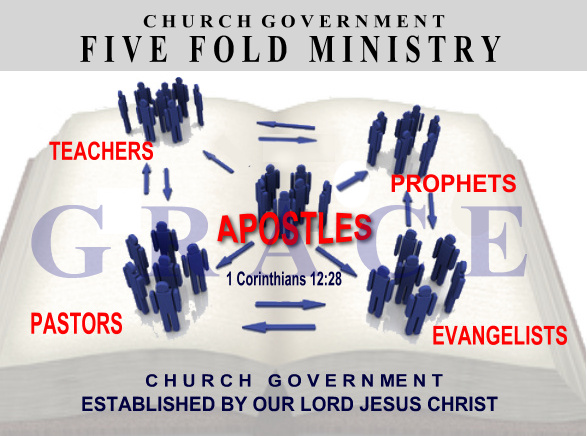
  • What about what some call the 5-fold ministry in Ephesians 4:11 or 1 Corinthians 12:28-29?
five-fold-ministry
  • Again, arguments that try to argue for modern apostles betray a misunderstanding of the different usage of apostle in the NT.
  • If the apostles had to be witnesses of Jesus earthly ministry and resurrection, as well as be verified by miraculous signs and wonders, then the only way for someone to be an apostle (in the specific sense) is to be 2,000 years old.
    • There are apostles all over the place in the general sense of “messenger” (in that sense, I’m an apostle too), but I’ve never once heard of someone who calls themselves an “apostle” in order to insinuate the same level of divine authority as this fellow.
    • As a general rule; “doctrines” that are built on a single verse of scripture (like Eph. 4:11, which is the only passage I’ve ever seen used to defend the concept of the “five-fold ministry”) are highly suspicious.
  • What was the relation of prophets and apostles?
    • Jesus paralleled prophets and apostles in Luke 11:49, and they’re spoken of in parallel language in Eph. 2:20, 3:5; 2 Pet. 3:2; and Rev. 18:20.
    • Both prophets and apostles speak for God, but only the apostles were messengers of Christ that were personally sent by him.
      • The big difference is Jesus.
      • In the NT, you have prophets who are not apostles (i.e. Agabus), but no apostles who are not prophets.
So, if someone calls themselves an “apostle” and is not a miraculously verified witness of both Christ’s earthly ministry and resurrection, then they’re basically using the term as synonymous with the term “Christian”.  If someone is not a miraculously verified witness of both Christ’s earthly ministry and resurrection but they call themselves an “apostle” because they’re planting churches, then they’re basically using the term as synonymous with the term “pastor”.
I hope that gives some food for thought and clears up the terminology confusion for you as much as it did for me!

9 LESSONS FROM GOD CONCERNING SICKNESS

Sickness is meant…

1. To make us think—to remind us that we have a soul as well as a body—an immortal soul—a soul that will live forever in happiness or in misery—and that if this soul is not saved we had better never have been born.
2. To teach us that there is a world beyond the grave—and that the world we now live in is only a training-place for another dwelling, where there will be no decay, no sorrow, no tears, no misery, and no sin.
3. To make us look at our past lives honestly, fairly, and conscientiously. Am I ready for my great change if I should not get better? Do I repent truly of my sins? Are my sins forgiven and washed away in Christ’s blood? Am I prepared to meet God?
4. To make us see the emptiness of the world and its utter inability to satisfy the highest and deepest needs of the soul.
5. To send us to our Bibles. That blessed Book, in the days of health, is too often left on the shelf, becomes the safest place in which to put a bank-note, and is never opened from January to December. But sickness often brings it down from the shelf and throws new light on its pages.
6. To make us pray. Too many, I fear, never pray at all, or they only rattle over a few hurried words morning and evening without thinking what they do. But prayer often becomes a reality when the valley of the shadow of death is in sight.
7. To make us repent and break off our sins. If we will not hear the voice of mercies, God sometimes makes us “hear the rod.”
8. To draw us to Christ. Naturally we do not see the full value of that blessed Savior. We secretly imagine that our prayers, good deeds, and sacrament-receiving will save our souls. But when flesh begins to fail, the absolute necessity of a Redeemer, a Mediator, and an Advocate with the Father, stands out before men’s eyes like fire, and makes them understand those words, “Simply to Your cross I cling,” as they never did before. Sickness has done this for many—they have found Christ in the sick room.
9. To make us feeling and sympathizing towards others. By nature we are all far below our blessed Master’s example, who had not only a hand to help all, but a heart to feel for all. None, I suspect, are so unable to sympathize as those who have never had trouble themselves—and none are so able to feel as those who have drunk most deeply the cup of pain and sorrow.
Summary: Beware of fretting, murmuring, complaining, and giving way to an impatient spirit. Regard your sickness as a blessing in disguise – a good and not an evil – a friend and not an enemy. No doubt we should all prefer to learn spiritual lessons in the school of ease and not under the rod. But rest assured that God knows better than we do how to teach us. The light of the last day will show you that there was a meaning and a “need be” in all your bodily ailments. The lessons that we learn on a sick-bed, when we are shut out from the world, are often lessons which we should never learn elsewhere.

~ J.C. Ryle

Monday, December 2, 2013

So who exactly IS the mainstream of the charismatic movement?

So who exactly IS the mainstream of the charismatic movement?

WHAT DOCTRINES ARE FUNDAMENTAL? PART 3

V. The Fundamental Doctrines Are All Summed up in the Person and Work of Christ
The Fundamental Doctrines Are All Summed up in the Person and Work of Christ.Paul wrote, "No man can lay a foundation other than the one which is laid, which is Jesus Christ" (1 Corinthians 3:11). Christ Himself embodied or established every doctrine that is essential to genuine Christianity. Those who reject any of the cardinal doctrines of the faith worship a "christ" who is not the Christ of Scripture.
How are the fundamentals of the faith personified in Christ?
With regard to the inspiration and authority of Scripture, He is the incarnate Word (John 1:1, 14). He upheld the written Word's absolute authority (Matthew 5:18). Christ Himself established sola Scriptura as a fundamental doctrine when He upbraided the Pharisees for nullifying Scripture with their own traditions: "Rightly did Isaiah prophesy of you hypocrites, as it is written, 'This people honors Me with their lips, but their heart is far away from Me. But in vain do they worship Me, teaching as doctrines the precepts of men.' Neglecting the commandment of God, you hold to the tradition of men.... You nicely set aside the commandment of God in order to keep your tradition" (Mark 7:6-9). Our Lord had much to say about the authority and infallibility of the Word of God.
In the doctrine of justification by faith, it is Christ's own perfect righteousness, imputed to the believer, that makes the pivotal difference between true biblical justification and the corrupted doctrine of Roman Catholicism and the cults. That is what Paul meant when he wrote, "Christ is the end of the law for righteousness to everyone who believes" (Romans 10:4). It is also why Paul wrote that Christ is become to us righteousness (1 Corinthians 1:30), and it is why Jeremiah called Him "The Lord our righteousness" (Jeremiah 23:6). The Lord Himself, Jesus Christ, is our righteousness (Jeremiah 33:16). That is the very essence of justification by faith alone, sola fide.
Of course, all the fundamental doctrines related to the incarnation -- the Virgin Birth of Christ, His deity, His humanity, and His sinlessness -- are part and parcel of who He is. To deny any of those doctrines is to attack Christ Himself.
The essential doctrines related to His work -- His atoning death, His resurrection, and the reality of His miracles -- are the very basis of the Gospel (cf. 1 Corinthians 15:1-4; Hebrews 2:3-4). Reject them and you nullify the heart of the Christian message.
The fundamentals of the faith are so closely identified with Christ that the apostle John used the expression "the teaching of Christ" as a kind of shorthand for the set of doctrines he regarded as fundamental. To him, these doctrines represented the difference between true Christianity and false religion.
That is why he wrote, "Anyone who goes too far and does not abide in the teaching of Christ, does not have God; the one who abides in the teaching, he has both the Father and the Son" (2 John 9). Far from encouraging union with those who denied the fundamental truths of the faith, John forbade any form of spiritual fellowship with or encouragement of such false religion (vv. 10-11).
So What?
It has not been my purpose here to attempt to give an exhaustive list of fundamental doctrines. Such a task is beyond the scope of this article. Furthermore, the attempt to precisely identify and number such a list of doctrines would be an extremely difficult thing to do. However, a reasonable list of fundamentals would necessarily begin with these doctrines explicitly identified in Scripture as non-negotiable: the absolute authority of Scripture over tradition (sola Scriptura), justification by faith alone (sola fide), the deity of Christ, and the Trinity.
But what are we to do with this understanding? First of all, we should resist any temptation to wield these doctrines like a judge's gavel that consigns multitudes to eternal doom. We must not set ourselves up as judges of other people's eternal fate.
On the other hand, we must recognize that those who have turned away from sound doctrine in matters essential to salvation are condemning themselves. "He who does not believe has been judged already" (John 3:18). Our passion ought to be to proclaim the fundamentals with clarity and precision, in order to turn people away from the darkness of error. We must confront head-on the blindness and unbelief that will be the reason multitudes will one day hear the Lord say, "I never knew you; depart from Me" (Matthew 7:23). Again, it must be stressed that those who act as if crucial doctrines were of no consequence only heap the false teacher's guilt on themselves (2 John 11).
We have no right to pronounce a sentence of eternal doom against anyone (John 5:22). But by the same token, we have no business receiving just anyone into the communion and fellowship of the church. We should no more forge spiritual bonds with people whose religion is fundamentally in error than we would seek fellowship with those guilty of heinous sin. To do so is tantamount to the arrogance shown by the Corinthians, who refused to dismiss from their fellowship a man living in the grossest kind of sin (1 Corinthians 5:1-3).
We must also remember that serious error can be extremely subtle. False teachers don't wear a sign proclaiming who they are. They disguise themselves as apostles of Christ (2 Corinthians 11:13). "And no wonder, for even Satan disguises himself as an angel of light. Therefore it is not surprising if his servants also disguise themselves as servants of righteousness" (vv. 14-15). In view of the current hunger for ecumenical compromise, nothing is more desperately needed in the church right now than a new movement to reemphasize the fundamental articles of the faith.

WHAT DOCTRINES ARE FUNDAMENTAL? PART 2

III. Everything Essential to Saving Faith Is Fundamental
Everything Essential to Saving Faith Is FundamentalThird, a doctrine must be regarded as fundamental if eternal life depends on it. Scripture is full of statements that identify the terms of salvation and the marks of genuine faith.
"Without faith it is impossible to please Him, for he who comes to God must believe that He is, and that He is a rewarder of those who seek Him" (Hebrews 11:6). That verse makes faith itself essential to a right relationship with God. It also expressly identifies both the existence and the veracity of God as fundamental articles of the Christian faith.
Elsewhere we are told that eternal life is obtained through the knowledge of the true God and Jesus Christ (John 17:3; 14:6; Acts 4:12). Since Jesus Himself is the true God incarnate (1 John 5:20; John 8:58; 10:30), the fact of His deity (and by implication the whole doctrine of the Trinity) is a fundamental article of faith (see 1 John 2:23). Our Lord Himself confirmed this when He said all must honor Him as they honor the Father (John 5:23).
The truths of Jesus' divine Sonship and Messiahship are also fundamental articles of faith (John 20:31).
Of course, the bodily resurrection of Christ is a fundamental doctrine, because 1 Corinthians 15:14 tells us, "If Christ has not been raised, then our preaching is vain, your faith also is vain."
Romans 10:9 confirms that the resurrection is a fundamental doctrine, and adds another: the lordship of Christ. "If you confess with your mouth Jesus as Lord, and believe in your heart that God raised Him from the dead, you shall be saved."
And according to Romans 4:4-5, justification by faith is a fundamental doctrine as well: "Now to the one who works, his wage is not reckoned as a favor, but as what is due. But to the one who does not work, but believes in Him who justifies the ungodly, his faith is reckoned as righteousness." In other words, those who seek acceptance before God on the ground of their own righteousness will find they fall short (Romans 3:27-28; Galatians 2:16-3:29). Only those who trust God to impute Christ's perfect righteousness to them are accounted truly righteous. This is precisely the difference between Roman Catholic doctrine and the Gospel set forth in Scripture. It is at the heart of all doctrine that is truly fundamental.
In fact, an error in understanding justification is the very thing that was responsible for the apostasy of the Jewish nation: "For not knowing about God's righteousness, and seeking to establish their own, they did not subject themselves to the righteousness of God" (Romans 10:3). Is that not the precise failure of Roman Catholicism? But "Christ is the end of the law for righteousness to everyone who believes" (v. 4).
IV. Every Doctrine We Are Forbidden to Deny Is Fundamental
Certain teachings of Scripture carry threats of damnation to those who deny them. Other ideas are expressly stated to be affirmed only by unbelievers. Such doctrines, obviously, involve fundamental articles of genuine Christianity.
The apostle John began his first epistle with a series of statements that establish key points of the doctrine of sin (hamartiology) as fundamental articles of faith. "If we say that we have fellowship with Him and yet walk in the darkness, we lie and do not practice the truth" (1:6). That condemns wanton antinomianism (the idea that Christians are under no law whatsoever) and makes some degree of doctrinal and moral enlightenment essential to true Christianity. A second statement rules out the humanistic notion that people are basically good: "If we say that we have no sin, we are deceiving ourselves, and the truth is not in us" (v. 8 ). And a third suggests that no true Christian would deny his or her own sinfulness: "If we say that we have not sinned, we make Him a liar, and His word is not in us" (v. 10).
First Corinthians 16:22 makes love for Christ a fundamental issue: "If anyone does not love the Lord, let him be accursed." And a similar verse, 1 Corinthians 12:3, says that no one speaking by the Spirit of God can call Jesus accursed.
The truth of Jesus' incarnation is also clearly designated a fundamental doctrine: "Every spirit that confesses that Jesus Christ has come in the flesh is from God; and every spirit that does not confess Jesus is not from God; and this is the spirit of the antichrist" (1 John 4:2-3). "For many deceivers have gone out into the world, those who do not acknowledge Jesus Christ as coming in the flesh. This is the deceiver and the antichrist" (2 John 7). Those verses by implication also condemn those who deny the Virgin Birth of our Lord, for if He was not virgin-born, He would be merely human, not eternal God come in the flesh.
And since those who twist and distort the Word of God are threatened with destruction (2 Peter 3:16), it is evident that both a lofty view of Scripture and a sound method of Bible interpretation (hermeneutics) are fundamental tenets of true Christianity.

Related Products (for purchase):

WHAT DOCTRINES ARE FUNDAMENTAL? PART 1

Psalm 19:7, 2 Timothy 3:17, Matthew 11:25,

By John MacArthur
How can a Christian determine which doctrines are essential and which are not?
The Right FoundationTo begin with, the strongest words of condemnation in all the New Testament are aimed at false teachers who corrupt the Gospel. Therefore the Gospel message itself must be acknowledged as a primary point of fundamental doctrine.
But what message will determine the content of our gospel testimony? Let's turn to Scripture itself and attempt to lay out some biblical principles for determining which articles of faith are truly essential to authentic Christianity. 
I. All Fundamental Articles of Faith Must Be Drawn from the Scriptures
First, if a doctrine is truly fundamental, it must have its origin in Scripture, not tradition, papal decrees, or some other source of authority. Paul reminded Timothy that the Scriptures are "able to make thee wise unto salvation" (2 Timothy 3:15, KJV). In other words, if a doctrine is essential for salvation, we can learn it from the Bible. The written Word of God therefore must contain all doctrine that is truly fundamental. It is able to make us "adequate, equipped for every good work" (2 Timothy 3:17). If there were necessary doctrines not revealed in Scripture, those promises would ring empty.
The psalmist wrote, "The law of the Lord is perfect, restoring the soul" (Psalm 19:7). That means Scripture is sufficient. Apart from the truths revealed to us in Scripture, there is no essential spiritual truth, no fundamental doctrine, nothing essential to soul-restoration. We do not need to look beyond the written Word of God for any essential doctrines. There is nothing necessary beyond what is recorded in God's Word.
This, of course, is the Reformation principle of sola Scriptura -- Scripture alone. According to the Bible itself, no supposed spiritual authority outside "the sacred writings" of Scripture can give us wisdom that leads to salvation. No papal decrees, no oral tradition, no latter-day prophecy can contain truth apart from Scripture that is genuinely fundamental.
II. The Fundamentals Are Clear in Scripture
Second, if an article of faith is to be regarded as fundamental, it must be clearly set forth in Scripture. No "secret knowledge" or hidden truth-formula could ever qualify as a fundamental article of faith. No cryptic key is necessary to unlock the teaching of the Bible.
The truth of God is not aimed at learned intellectuals; it is simple enough for a child. "Thou didst hide these things from the wise and intelligent and didst reveal them to babes" (Matthew 11:25, KJV). The Word of God is not a puzzle. It does not speak in riddles. It is not cryptic or mysterious. It is plain and obvious to those who have spiritual ears to hear. "The testimony of the Lord is sure, making wise the simple" (Psalm 19:7).
The point is not that every fundamental article of faith must be supported with an explicit proof text. The doctrine of the Trinity, for example, is certainly essential to true Christianity-and it is very clear in Scripture-but you will find no comprehensive statement of the Trinity from any single passage of Scripture.
This does not mean that a doctrine must be non-controversial in order to be considered a fundamental article. Some would argue that the only test of whether something is essential to true Christianity is whether it is affirmed by all the major Christian traditions. By that rule, hardly anything of any substance would remain to distinguish the Christian Gospel from the "salvation" offered by pagan morality or Islamic theology. "There is much truth in the remark of Clement of Alexandria; 'No Scripture, I apprehend, is so favourably treated, as to be contradicted by no one.'" (Herman Witsius, Sacred Dissertations on the Apostles' Creed [Phillipsburg, NJ: Presbyterian & Reformed, 1993 reprint], 1:21)


Related Products (for purchase):

The story of Lucy Nduta: of ravenous false prophets and dead sheep

This post originally appeared here

Readers of this blog are aware that I enjoyed the good biblical preaching at the recent Strange Fire conference. That was a conference that sought to refute the claims of the Charismatic movement, to rebuke the leaders of it, and to urge the brethren to pray for discernment so they will be able to detect falsity if it creeps in to their church (or heart).

The Charismatic movement is a movement which is based on the unbiblical notion that personally delivered prophecies, babbling tongues, and healing by men laying hands on the sick (sign gifts) are still going strong as they were at Pentecost and during the Apostolic era.

These sign gifts have ceased, and the preaching at the conference showed this. One of the speakers was Pastor Conrad Mbewe. Pastor Mbewe is pastor of Kabwata Baptist Church in Zambia, Africa. He spoke at John MacArthur's Strange Fire conference in Sun Valley, Calif., on Oct. 18, 2013. His first sermon was titled,  The African Import of Charismatic Chaos. He has been observing the growth of the Charismatic movement in his nation and beyond, for over thirty years. He has personally been impacted by it, as he said, not just from books but in every day life.

His second message was titled "Are We Preachers or Witch Doctors?" In this sermon, Pastor Mbewe related how the African mindset of the lost person, having been drenched in witch doctor superstition, will readily accept the unbiblical precepts inherent in the Charismatic movement because the two are extremely similar.

The lost person is desperate. It is the default condition of the lost person. They are wandering, empty, their lives are void of meaning. They also have life issues that may be very difficult to deal with and because they don't have Christ, they do not have a lasting coping mechanism.

The sick, particularly, look for cures from any quarter: medicines, homeopathic, psychology, or spiritual remedies. The sick are often all too vulnerable and willing to grasp any person who claims to have a way, a cure, a method.

This is where Lucy Nduta comes in.

This woman is from Kenya. She calls herself Prophetess Lucy Nduta, and she preaches. In 2007, Worldwide Religious News printed the following, originally printed in the East African Standard

Churches Sow Miracles
"Nairobi, Kenya - The sprouting of countless charismatic churches in the country has heralded a new breed of church leaders and worshippers with strong faith in the power of miracles. An increasing number of Kenyans are turning to 'sowing the seed' (giving huge sums of money for offering and tithe) at the prompting of church ministers who promise them to expect prosperity. However, it appears there are 'men and women of God' who are out to take advantage of the unwavering faith and ignorance of worshippers. These are people who hide self-interest under the cloak of religion. They quote biblical verses to suit their intentions and convince the congregation of the need to give more in order to receive more."

What Lucy Nduta did was, in the name of Jesus, take sick people's money, supposedly pray for them, and lie to them they were healed. But it gets worse, because it gets more diabolical.

Nduta preyed on people with HIV/AIDS, a scourge that particularly affects the people of the African continent. Nduta would claim that she had the power to heal people suffering from HIV/AIDS through her miracle working porayers, and then herd them to a clinic/lab she had built near her church. The sick people would get tested there, and because Nduta owned the lab, she would have the workers give clean bills of health to these unfortunately trusting people, lab reports that were totally bogus. The people really thought they were cured, and sought no further treatment. And of course in gratitude they tithed heavily to Nduta. They, they died.

The Africa Report stated, "The police later found out that the clinics were her own creation to lure people. She was consequently sentenced to two years in prison. Despite these revelations, thousands still fill churches each Sunday waiting for miracles to happen in their lives."

Nduta was sentenced in 2008 and got out of prison in 2010.

False pastors who shred the sheep are a scourge. When the verse says-

"Beware of false prophets, who come to you in sheep’s clothing but inwardly are ravenous wolves."(Matthew 7:15)

Ravenous means, 'Extremely hungry; voracious, Rapacious; predatory, Greedy for gratification'. Ravenous predators never stop. They eat and kill and eat and kill. That is what they do.

Nduta and now her son, are at it again. This report is from last week, Nov 4, 2013-

"Self-styled prophetess Lucy Nduta Mwangi has called in to defend her activities and that of her son, another self-declared prophet Victor Kanyari. Nduta says there is nothing wrong with what she and her son have been doing adding that they will continue asking for what is called seed money.

The report above ends with the announcer stating that the Evangelical Alliance of Kenya will convene to discus and strategize how to deal with the sudden rise of fake preachers in Kenya.

Ravenous is what wolves are. So if you believe that opening yourself just a tiny bit to doctrines which false prophets bring, you are very, very wrong.

An appalling and horrible thing has happened in the land: the prophets prophesy falsely, and the priests rule at their direction; my people love to have it so, but what will you do when the end comes?  (Jeremiah 5:30-31)